Strong Fundamentals with Fragile Sentiments: Assessing Indonesia’s Economic Resilience Against Global Shocks
"Indonesia’s economy may appear stable on paper, but beneath its strong fundamentals lies a growing crisis of market confidence driven by global shocks and domestic uncertainty."
Nicholas Matthew
Diterbitkan pada 25 Mei 2026
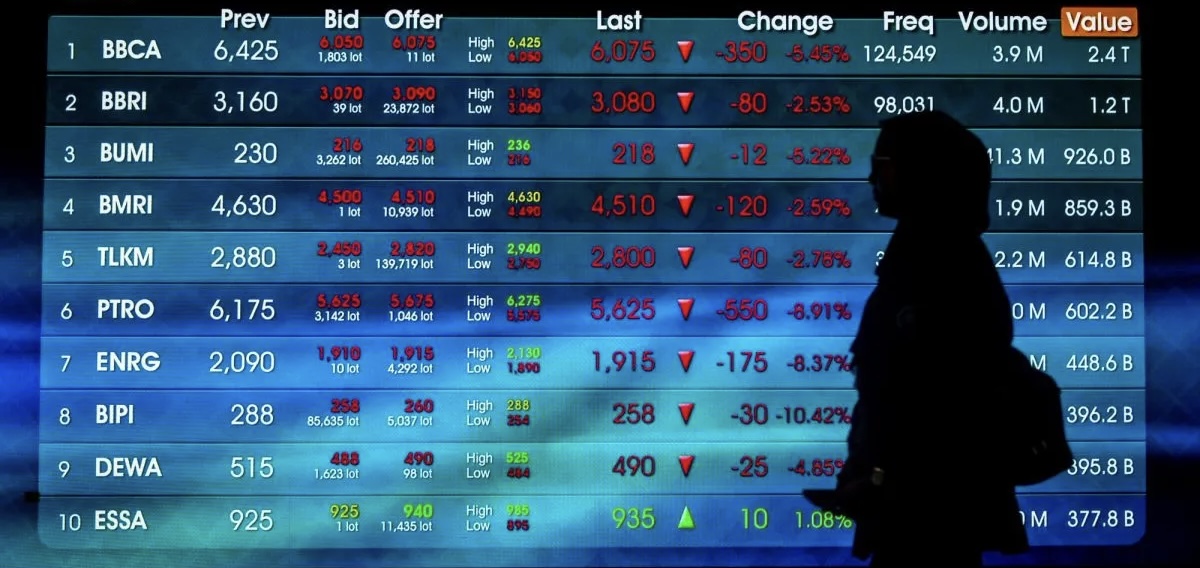
On paper, Indonesia’s economic growth appears to be normal, at around 5 percent, the same figure as in recent years. However, for financial practitioners, 2026 began with a wave of anxiety that persisted. It began with global economic issues triggered by the outbreak of tensions in the Middle East, culminating in the decline of the Rupiah and the IDX composite (ICI), which continued to deviate from its fundamental value. By the end of April, the Rupiah had surpassed its weakest level since the 1998 crisis, and as of the date of this article’s writing (May 19, 2026), the Rupiah’s exchange rate has not improved and has worsened each week. This is evidenced by the ICI’s continued decline to 8%, which began in late January following Morgan Stanley Capital International (MSCI)’s announcement of a suspension of changes to Indonesian constituent stocks. The Indonesia Stock Exchange (IDX) also held negotiations with MSCI, and the ICI rebounded and reached an all-time high on January 20, 2026. However, since then, it has continued to decline until it reached its lowest point in the past year in mid-May.
Differences between Real Economy and Financial Sector
To understand the decline in the Rupiah exchange rate and the ICI amid stable GDP growth, we must distinguish between the real economy and the financial economy. Indonesia’s 5.11% GDP growth at the end of 2025 is a lagging indicator. This figure reflects past performance, including strong household consumption and ongoing manufacturing activity. The real economy moves slowly, taking time to grow or decline.
In contrast, the Rupiah and the ICI exchange rates move based on future expectations and short-term sentiment. Investors don’t invest solely based on current events, but rather predict and project future developments. Increased global volatility since early 2026 has caused many investors, particularly foreign investors, to adopt a preemptive stance and withdraw their investments. This has led to a divergence where production continues, GDP remains stable, but funds are diverted to safer assets, or safe havens, which has caused the Rupiah and the ICI to decline.
External Pressures and Global Market Phenomena
Economic divergence explains that in addition to the importance of a country’s macroeconomic fundamentals, external factors also impact the domestic market, particularly decisions made by the United States, the hegemonic economy. Throughout 2026, the United States Federal Reserve (The Fed) decided to maintain its interest rate at 3.50-3.75%. This policy was taken because The Fed considered the continued high domestic inflation in the United States, caused by tensions in the Middle East. Throughout 2026, a net sale of 40.82 trillion Rupiah in foreign funds was recorded by foreign investors.
The tensions in the Middle East have also impacted the global economy. Political tensions amid the Israel-Iran war have created new policies that have put pressure on the global economy. The most damaging policy was Iran’s closure of the Strait of Hormuz, restricting the free passage of ships. The Strait of Hormuz is a vital access point for the distribution of 20% of the world’s oil supply, and these restrictions have led to massive inflation across the globe, including Indonesia. The increase in fuel prices in Indonesia has contributed an additional 0.04 to 0.15% to inflation, triggering a revision of the year-end inflation projection to 3.5%.
These two phenomenons have impacted the Indonesian economy, with many foreign investors withdrawing from the Indonesian market, leading to capital outflow. This was driven by two main factors: first, policy uncertainty. In early 2026, Moody’s Corporation downgraded Indonesia’s credit rating outlook to negative. This was triggered by declining predictability and coherence in policy formulation, which led foreign investors to choose to wait, observe, and secure their capital out of Indonesia. Second, low market liquidity. A liquid market is one with a fast turnover rate, meaning investors can invest and quickly generate profits. However, negative sentiment from MSCI, which froze several stocks due to transparency issues, has raised fears among foreign investors about being trapped in a market with no quick exit, leading them to opt out to mitigate potential risks.
Policies in Stabilization Efforts
Given the high level of capital outflow by foreign investors and reduced market liquidity, there’s a need for intervention from the Bank of Indonesia and the government to address the problems that occur. The Bank of Indonesia itself has implemented several policies, namely the triple intervention policy, by supplying United States dollars, managing future exchange rate expectations, and purchasing government bonds released by foreign investors, a proactive interest rate policy, by holding the benchmark interest rate at 4.75% to maintain the interest rate differential with the Fed, and a policy of optimizing Bank Indonesia Rupiah Securities as a short-term monetary instrument.
From the fiscal side itself, the government is maintaining the fiscal deficit by tightening spending and keeping the state budget deficit below the law (3% of GDP) and by providing foreign exchange incentives from export proceeds by requiring commodity exporters to deposit export proceeds in domestic banks for a certain period to increase national foreign exchange liquidity.
Conclusion
In 2026, Indonesia’s economic resilience will face a significant test. Given the uncertainty of global geopolitical and economic conditions, it is undeniable that the significant challenge of restoring Indonesia’s economic health lies ahead. However, despite the importance of government cooperation with the central bank in addressing this issue, many state officials still fail to view the challenges as ones that must be addressed together. For example, the Indonesian Finance Minister, Purbaya Yudhi Sadewa, has repeatedly seemed to shift responsibility solely to Bank Indonesia when asked about the weakening Rupiah exchange rate, as well as the recent statement by Indonesia’s 8th President, Prabowo Subianto, regarding rural communities not using USD as a means of transaction.
This certainly raises major questions about the government’s seriousness in response to the increasingly difficult economic situation. If not addressed seriously, the weakening of the USD against the Rupiah to more than 18,000 rupiah is only a matter of months, or even weeks, and the question remains: how long will the ICI survive?
Nicholas Matthew is an undergraduate student of the Business and Economics Program at Tokyo International University, he also serves as the Commissioner of the Supervisory Board in PPI Korda Kanto. With a strong research interest in development economics and macroeconomic policy, his academic focus centers on examining how global financial shocks and monetary dynamics impact real sector growth in emerging markets.